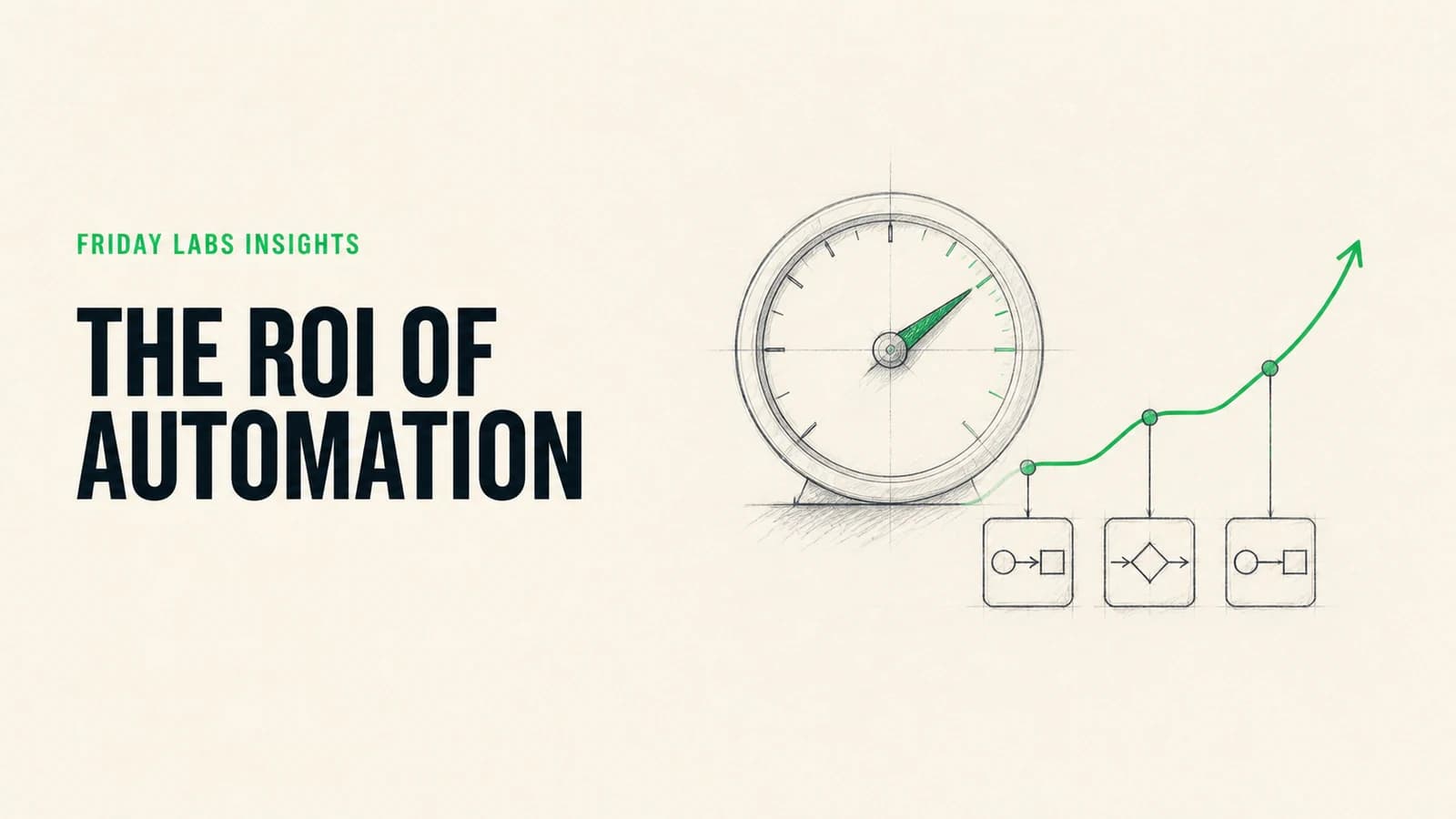
Every automation pitch ends with "it will save you time." That is not a number. Before you build anything, or pay anyone to build it, you should be able to say what the automation returns per month and how fast it pays for itself.
Here is the simple math we use to qualify every build, with a worked example you can copy.
The formula
Automation ROI comes down to four inputs:
- Hours saved per month. Count every person the process touches, not just the owner.
- Loaded hourly cost. Salary plus taxes, benefits, and overhead. A quick shortcut: annual salary divided by 1,000 gives a rough loaded hourly rate.
- Error cost. What mistakes in this process cost you monthly: refunds, churned clients, missed leads, rework.
- Build and run cost. What it costs to build the automation, plus any monthly tool fees.
Then:
Monthly return = (hours saved x loaded hourly cost) + error cost avoided
Payback period = build cost / monthly return
A worked example
Say your operations manager spends 90 minutes every weekday assembling a report from three tools, and mistakes in that report cause roughly one $500 problem a month.
| Input | Value |
|---|---|
| Hours saved per month | 1.5 hrs x 21 workdays = 31.5 hrs |
| Loaded hourly cost | $85,000 salary, roughly $85/hr loaded |
| Error cost avoided | $500/month |
| Build cost (one time) | $4,000 |
| Tool cost | $50/month |
Monthly return = (31.5 x $85) + $500 - $50 = $3,127 per month
Payback period = $4,000 / $3,127 = about 5 weeks
After payback, this single automation returns about $37,000 a year. That is the kind of math that should exist for every build in your roadmap before anyone writes a line of code.
Three rules that keep the math honest
Count the whole chain. A quote that takes your salesperson 20 minutes also takes your admin 10 minutes to log and your bookkeeper 5 minutes to reconcile. Automating it saves 35 minutes, not 20.
Use loaded cost, not salary. An employee costs roughly 1.25 to 1.4 times their salary once taxes, benefits, software seats, and management overhead are included. Using bare salary understates every return.
Discount the estimate, then decide. Cut your projected hours saved by 30 percent before computing payback. If the build still pays back within a quarter, it is a strong yes. If it only works with perfect assumptions, it is a no, or at least not yet.
What most businesses get wrong
The most common mistake is building the most impressive automation instead of the highest-returning one. A customer-facing AI chatbot demos beautifully. But if your team loses 30 hours a month to manual invoicing and 3 hours a month to answering repeat questions, the boring invoicing fix returns ten times more.
Rank every idea by monthly return divided by build cost, build from the top of the list, and reinvest the saved hours into the next build. That compounding is where automation stops being a cost and starts being a growth lever.
The bottom line
If you cannot put a number on an automation, do not build it yet. Thirty minutes with this formula will tell you more than any product demo, and it gives you a ranked roadmap instead of a wish list.