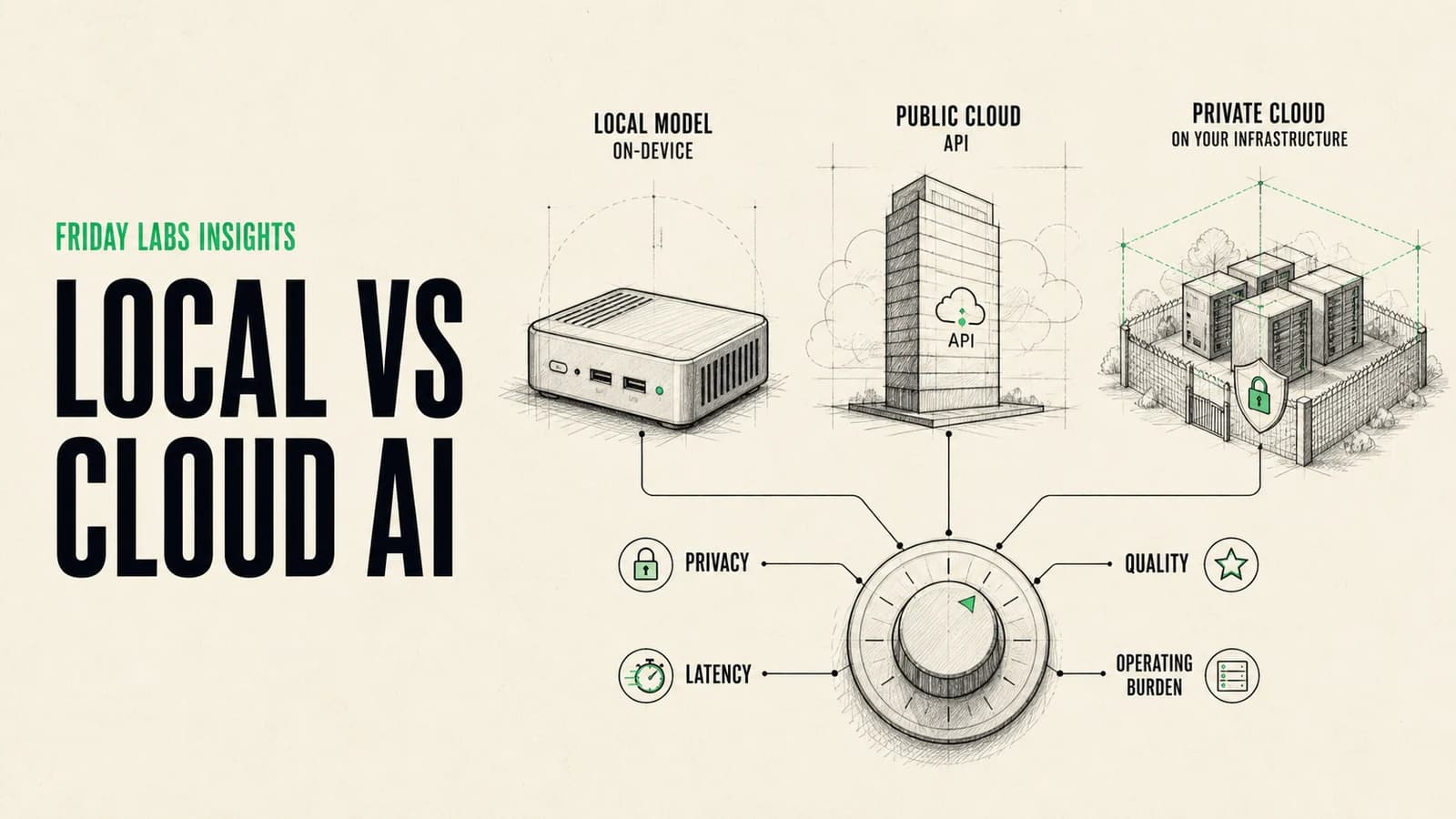
Businesses do not choose an AI deployment model on privacy alone.
They are balancing data exposure, model quality, latency, reliability, cost, customization, and the internal capacity to operate infrastructure. Local models, public cloud APIs, and private cloud endpoints each make different tradeoffs.
The correct answer is often a routing policy that uses more than one.
The short answer: Use a managed cloud API when speed, model quality, and low operational burden matter most. Use a local model when data must remain on controlled hardware, offline operation matters, or a stable high-volume task fits available hardware. Use private cloud when enterprise network and identity controls are required but the company still wants managed model infrastructure. Evaluate the complete data path, not only where inference runs.
Define the three options clearly
Cloud API
Your application sends a request to a model provider’s managed API. The provider operates the model, inference hardware, scaling, and most of the platform reliability.
Examples include model APIs offered directly by AI companies and managed model services accessed over the public internet with authenticated and encrypted connections.
Local or self-hosted model
Your organization runs model weights on hardware it controls. That may be a developer laptop, an office workstation, an on-premises server, a rented GPU, or infrastructure in your own cloud account.
“Local” and “self-hosted” are not always the same. A model running on a laptop can operate locally. A model deployed to your cloud virtual machine is self-hosted but not physically local.
Private cloud model endpoint
A cloud provider or model platform operates the service, but access is connected to the organization’s private network, cloud account, identity system, and policy controls. The endpoint may use private networking so traffic does not traverse the public internet.
Private cloud is not the same as running the model yourself. The organization gains network isolation and enterprise controls while the provider still manages substantial infrastructure.
Comparison at a glance
| Area | Cloud API | Local or self-hosted | Private cloud |
|---|---|---|---|
| Setup speed | Fastest | Slowest | Moderate |
| Access to leading models | Usually strongest | Depends on available open models and hardware | Strong, limited to provider catalog |
| Infrastructure ownership | Provider | Your team | Shared with cloud provider |
| Data path control | Contract and provider controls | Highest potential control | Strong network and account controls |
| Scaling | Managed | Your responsibility | Managed or jointly configured |
| Offline use | No | Yes, if fully local | No |
| Unit economics | Usage-based | Hardware plus operations | Usage and cloud infrastructure |
| Best fit | Fast deployment and variable demand | Restricted, offline, or stable specialized workloads | Regulated or enterprise cloud environments |
No option is automatically secure, cheap, or fast. Implementation determines the result.
Cloud APIs: the practical default for most teams
Managed APIs remove a large amount of infrastructure work. A team can test several models, scale usage, and receive platform improvements without managing GPUs or inference servers.
They are usually the best starting point when:
- The workload is new or demand is uncertain.
- Access to high-performing models matters.
- The team wants fast iteration.
- Usage is variable or bursty.
- The organization does not operate machine-learning infrastructure.
- Built-in safety, observability, and enterprise controls meet requirements.
The privacy question is contractual and technical
Sending data to a cloud API does not automatically mean the provider trains on it. Policies vary by product and contract.
OpenAI states in its enterprise privacy commitments that business and API data is not used to train models by default. Its API data controls describe default abuse-monitoring retention and options such as Modified Abuse Monitoring and Zero Data Retention for eligible customers and endpoints.
That is one part of the assessment. Teams should also review:
- Which endpoint and account tier they are using.
- Retention and abuse-monitoring terms.
- Subprocessors and data residency.
- Encryption in transit and at rest.
- Who can access provider dashboards and logs.
- Whether prompts are copied into an application monitoring tool.
- Whether third-party connectors receive the same content.
The model provider is only one link in the chain.
Local models: control with a real operating cost
Local inference can keep prompts and outputs on controlled hardware and support work without an internet connection. Tools such as Ollama make it easier to run compatible models on a workstation or server. Ollama’s FAQ explains how local runs keep prompts and data local and how cloud features can be disabled.
Local models make sense when:
- Policy prohibits sending the data to an external model service.
- The application must work offline or in a disconnected environment.
- The task is narrow, stable, and well served by an available model.
- Latency to a remote endpoint is unacceptable.
- Usage is high and predictable enough to justify dedicated hardware.
- The team needs control over model weights or inference settings.
Local does not mean zero exposure
Data can still leak through application logs, analytics, backups, remote administration, malware, or a retrieval system connected to external services. A local model inside an insecure application is not a private system.
Review the complete architecture:
- Where files are stored.
- How prompts are assembled.
- Whether embeddings are created externally.
- Which telemetry is enabled.
- How users authenticate.
- Who can access the host.
- How disks and backups are encrypted.
- How model and application updates are verified.
Hardware is part of product design
Model size, context length, quantization, concurrency, and latency all affect hardware requirements. Ollama’s GPU documentation lists supported acceleration platforms, but support alone does not guarantee acceptable performance for a specific model and workload.
Benchmark with representative inputs. A demo that answers one short prompt does not prove the system can support several users, long documents, retrieval, and tool calls at a useful speed.
Private cloud: enterprise controls without owning every layer
Private cloud model services are useful when an organization already has mature cloud networking, identity, logging, and governance.
For example, Azure documents how to access Azure OpenAI through a private endpoint, which can restrict service access to approved virtual networks. Amazon Bedrock states that customer content is isolated, encrypted, and not used to improve base models in its generative AI security reference architecture.
Private cloud can provide:
- Private network paths.
- Cloud identity and role controls.
- Centralized policy and audit logs.
- Regional deployment options.
- Managed scaling and model catalogs.
- Integration with existing data and security services.
It also introduces cloud architecture work. Network rules, identity permissions, data services, logs, and application endpoints must be configured correctly. A private endpoint does not make every connected service private by association.
Compare the total cost of ownership
Model price is only one line item.
Cloud API costs
- Input and output usage.
- Retrieval, storage, and tool APIs.
- Premium throughput or regional options.
- Observability and application infrastructure.
- Engineering time to optimize calls and caching.
Local or self-hosted costs
- GPU or accelerator hardware.
- Power, cooling, and physical capacity for on-premises systems.
- Cloud GPU time for hosted systems.
- Model serving and orchestration software.
- Availability, backups, updates, and security.
- Capacity reserved for peak usage.
- Staff time to benchmark and operate the service.
Private cloud costs
- Model usage.
- Cloud networking and private endpoints.
- Data transfer and storage.
- Security, logging, and governance services.
- Platform engineering and enterprise support.
For low or variable volume, a managed API often wins economically because the team pays for usage rather than idle capacity. For high, steady, well-understood workloads, self-hosting can become competitive. The crossover depends on the model, hardware utilization, reliability target, and labor cost.
Do not calculate self-hosting as “GPU bill only.”
Quality and model choice
Deployment strategy should follow the task’s quality requirement.
A smaller local model may be excellent for classification, extraction, routing, or constrained drafting. It may struggle with long-context reasoning, unfamiliar domains, complex tool use, or nuanced writing compared with a leading managed model.
Build an evaluation set and compare candidates on:
- Task accuracy.
- Grounding and hallucination rate.
- Structured output validity.
- Tool selection.
- Latency under realistic concurrency.
- Cost per successful task.
- Failure behavior.
The cheapest model call is not economical if human correction removes the savings.
Latency and availability
Local inference can reduce network travel, but queueing on limited hardware may erase that advantage. Cloud APIs add network latency but can scale across many simultaneous requests. Private cloud adds network design choices that may improve isolation while introducing regional dependencies.
Measure end-to-end latency, including retrieval, tool calls, validation, and approvals. Users experience the complete workflow, not the model benchmark.
Plan for outages in every architecture:
- Cloud API: provider outage, rate limit, or network failure.
- Local: host failure, overloaded GPU, failed update, or power event.
- Private cloud: regional service issue, identity failure, or network misconfiguration.
Define whether the system retries, queues work, switches models, degrades to a simpler process, or hands the task to a human.
A hybrid routing strategy
Many organizations should not pick one model path for every task.
A routing layer can send:
- Low-risk general tasks to a managed cloud model.
- Restricted documents to a local or private endpoint.
- High-complexity reasoning to a stronger model after redaction.
- High-volume classification to a smaller, cheaper model.
- Failed or uncertain outputs to a human.
The routing policy should be deterministic and auditable. Define data classes, approved providers, model capabilities, and fallback behavior. Do not ask another model to improvise the privacy policy at runtime.
A deployment decision checklist
Data
- What information enters the model request?
- Can it be minimized, tokenized, or redacted?
- Where are prompts, outputs, embeddings, and traces stored?
- Which retention and deletion rules apply?
Quality
- Which tasks and edge cases must the model handle?
- What score is acceptable?
- How much human correction is required?
Operations
- Who owns availability, updates, capacity, and incident response?
- What is the fallback during failure?
- How quickly must a security patch be applied?
Economics
- What is the expected and peak volume?
- What is the cost per successful business outcome?
- What labor is required to operate each option?
Governance
- Which users and systems may call the model?
- Which tools and records can it access?
- Which actions require approval?
- Can every consequential run be reconstructed?
Supporting video: AWS explains the data, network, identity, and governance controls available when teams build generative AI applications in a managed cloud environment.
Frequently asked questions
Are local AI models more private than cloud APIs?
They provide more direct control over inference data, but privacy depends on the whole system. Application logs, retrieval services, backups, remote access, and telemetry can still expose information.
What is the difference between private cloud and self-hosted AI?
Private cloud typically means a provider manages the model service inside an enterprise-controlled network and cloud account. Self-hosted means your organization operates the model server and is responsible for its availability, updates, and capacity.
Do cloud AI providers train on business API data?
Policies differ. Some business API providers state that they do not train on customer data by default, but retention, monitoring, and product-specific terms still apply. Review the exact service and contract.
When is self-hosting cheaper?
It can be cheaper for high, predictable utilization on a model that performs well with available hardware. Include engineering, reliability, security, and idle capacity in the comparison.
Can one application use local and cloud models?
Yes. A hybrid router can select an approved model based on data classification, task complexity, latency, and cost. Keep the routing rules explicit and observable.
Sources and methodology
This guide uses current primary documentation from OpenAI, Microsoft Azure, AWS, and Ollama. Friday Labs helps businesses evaluate and integrate AI systems; we do not claim to operate a proprietary model-hosting platform. Deployment decisions should also be reviewed against your organization’s legal, security, and compliance requirements.